Importing from China: A Guide to Product Compliance and Certification
Navigating international compliance can feel like a maze, but getting it right is the definitive line between a successful launch and a shipment seized at customs. When sourcing from China for any market abroad—such as the US, EU, or Australia—your strategy hinges on whether you are developing a custom product or purchasing off-the-shelf goods. It is vital to remember that compliance is region-specific; meeting Chinese domestic regulations (GB standards) does not grant automatic entry into other global markets.
To illustrate this regulatory gap, consider lighting products—a high-risk category where compliance is strictly enforced to prevent fire and shock hazards. While many Chinese factories produce high-quality LEDs, a product engineered for the Chinese domestic market rarely conforms to Australian standards (AS/NZS) without significant technical modifications.
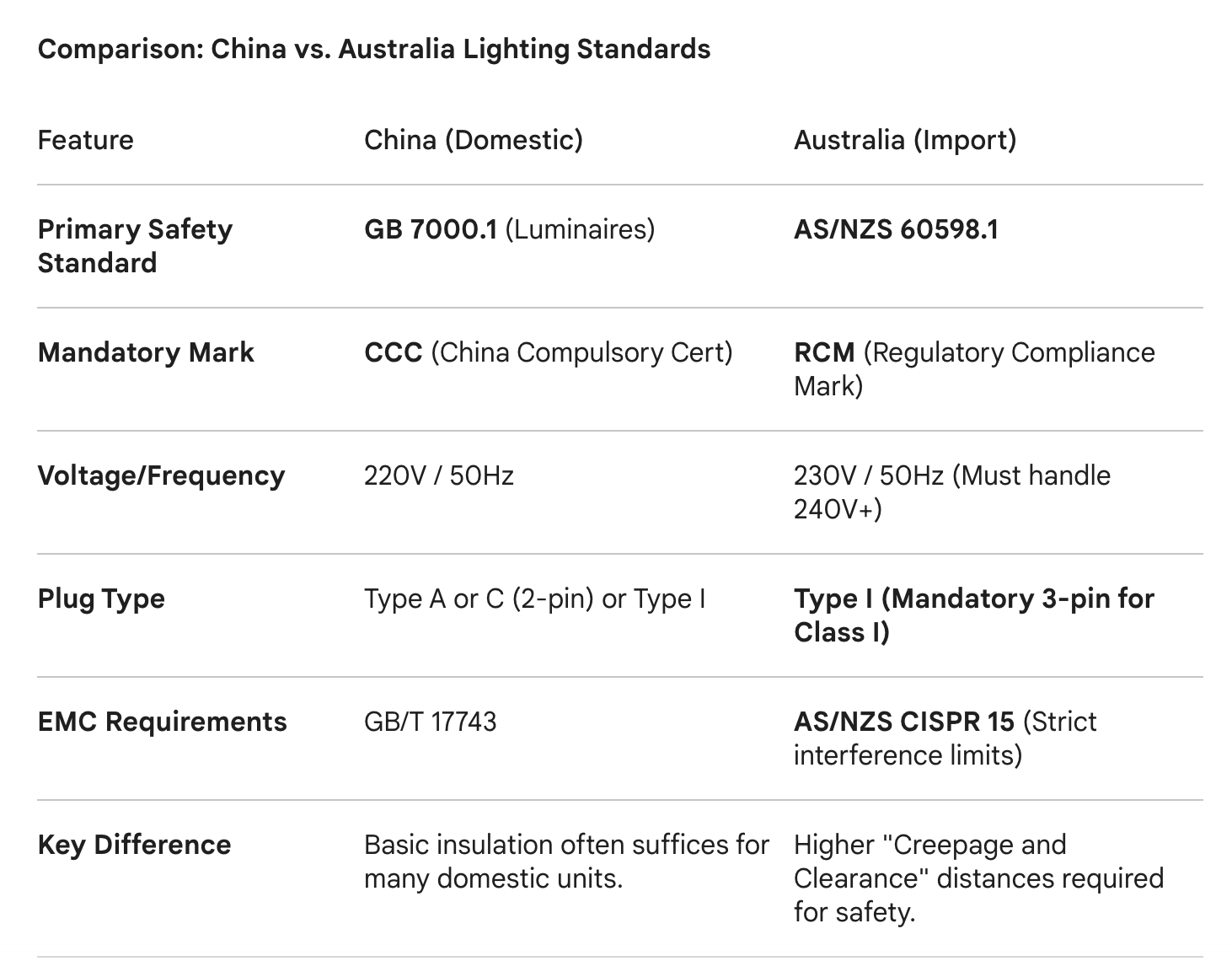
Lighting Standards Comparison: China (CCC) vs. Australia (RCM)
Here is how to ensure your products are market-ready.
1. Customized Products (OEM/ODM)
When you are manufacturing a product to your own specifications, compliance starts at the design phase. A factory cannot meet a standard they aren’t aware of.
Specify Standards Early: Don't just ask for "high quality." Explicitly list the required certifications (e.g., UL/FCC for the US, CE/RoHS for Europe, or AS/NZS for Australia) in your initial Request for Quotation (RFQ).
The "Golden Sample" Rule: Before mass production begins, have the factory produce a prototype. Send this sample to a third-party lab (like SGS, Intertek, or TÜV) to ensure the design actually meets the regulations before you hit "start" on the full order.
Detailed Tech Packs: Ensure your technical drawings and Bill of Materials (BOM) include requirements for non-toxic materials or specific safety components required by your target market.
2. Non-Customized (Off-the-Shelf) Products
Many importers assume that if a product is sold globally, it’s automatically compliant. This is a risky assumption. Products made for the Chinese domestic market (GB standards) often look identical to export versions but may use different internal components or materials.
The "Domestic Trap": Compliance with Chinese domestic regulations does not guarantee adherence to international standards. Because safety and technical requirements are region-specific, a product must be explicitly verified against the legal framework of your target market.
Verify Existing Reports: If a supplier claims to have a "CE certificate," ask for the full test report. Check the date, the company name, and verify the report number directly on the issuing lab’s website.
Batch Testing: Even if a factory has passed a test in the past, standards change. For peace of mind, arrange for a random sample from your specific batch to be tested before the final balance is paid.
3. The Logistics of Testing
In the real world, who pays for the testing? It’s often a point of negotiation.
Who Pays? For large orders (meeting a specific MOQ), many factories will agree to absorb the testing costs or credit them back to you upon a successful pass. For smaller orders, the importer usually bears the cost.
Accredited Labs: Customs authorities and major retailers generally only accept reports from recognized, independent third parties.
Pro-Tip: Consult Local Regulators
Before you wire any funds, check with your local customs broker or market regulator (like the CPSC in the US or ACCC in Australia). Requirements for labeling, packaging, and "Country of Origin" markings are just as important as the product's safety itself.